AI
Your Business May Rank on Google — But Does AI Recommend It?
A strong Google ranking and strong AI visibility are not the same thing. Here's why that gap exists, why it's becoming a serious marketing category, and what to do about it.
Your business can be visible on Google and still be missing from AI conversations
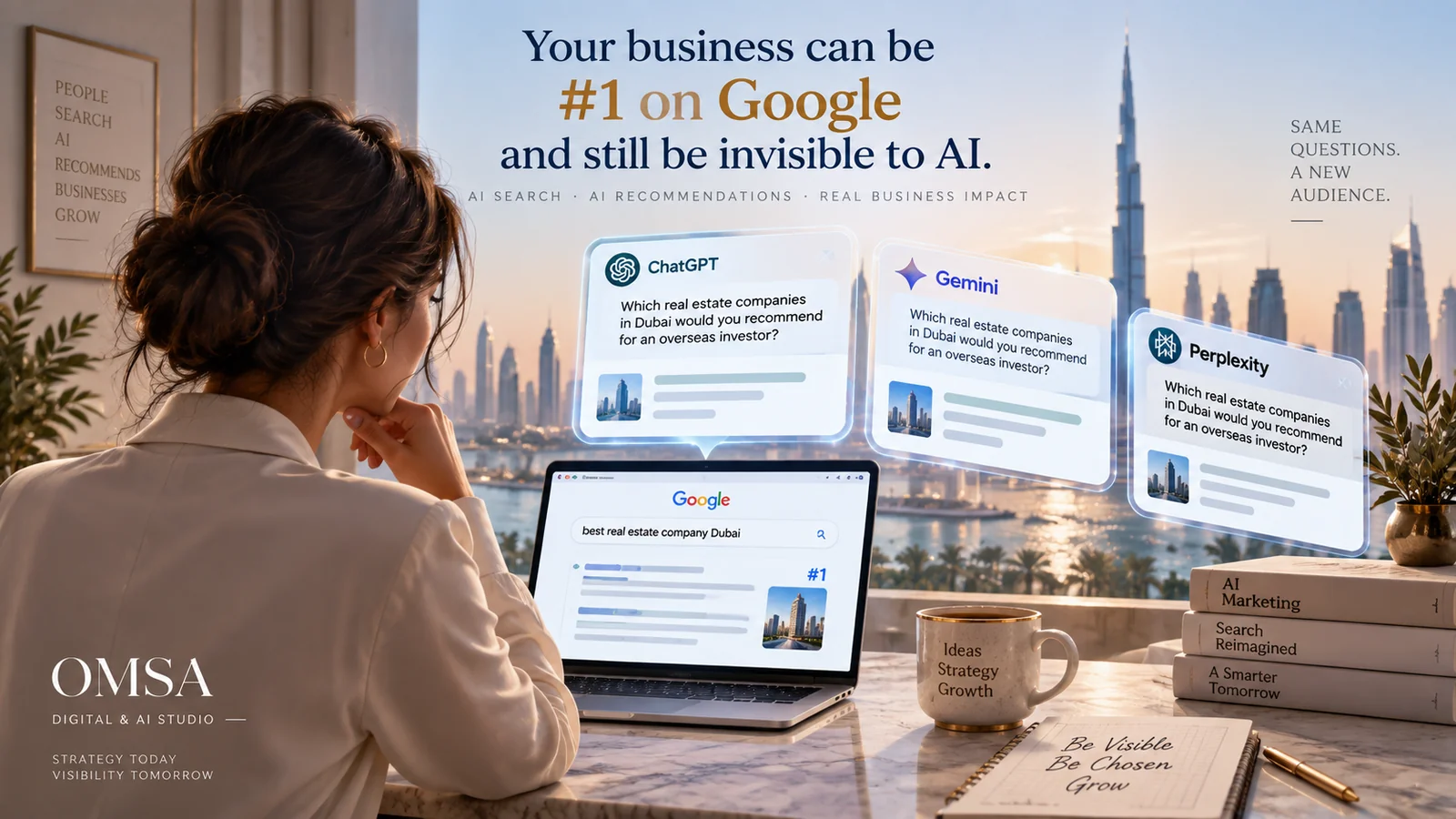
Your business can rank on the first page of Google and still be largely absent from the answer a customer gets when they ask an AI assistant for a recommendation instead. That's not a universal rule — strong Google rankings and strong AI visibility often reinforce each other — but they are not the same thing, and treating them as identical is becoming a real blind spot for businesses that measure their marketing only through search rankings.
Consider two searches that sound almost identical. A traditional search — "best real estate company Dubai" — returns a ranked list of results the person still has to open, read and compare. A conversational query to an AI assistant — "Which real estate companies in Dubai would you recommend for an overseas investor?" — returns a synthesized answer that may name a small number of businesses directly, drawn from wherever the system has formed its understanding of that category.
These are two different discovery journeys, built on different mechanics, and doing well in one doesn't guarantee doing well in the other. This article looks at why that gap exists, what's currently making it a serious commercial question rather than a theoretical one, and what a business in Oman, the UAE or the wider GCC can realistically do about it.
Search is becoming a recommendation conversation
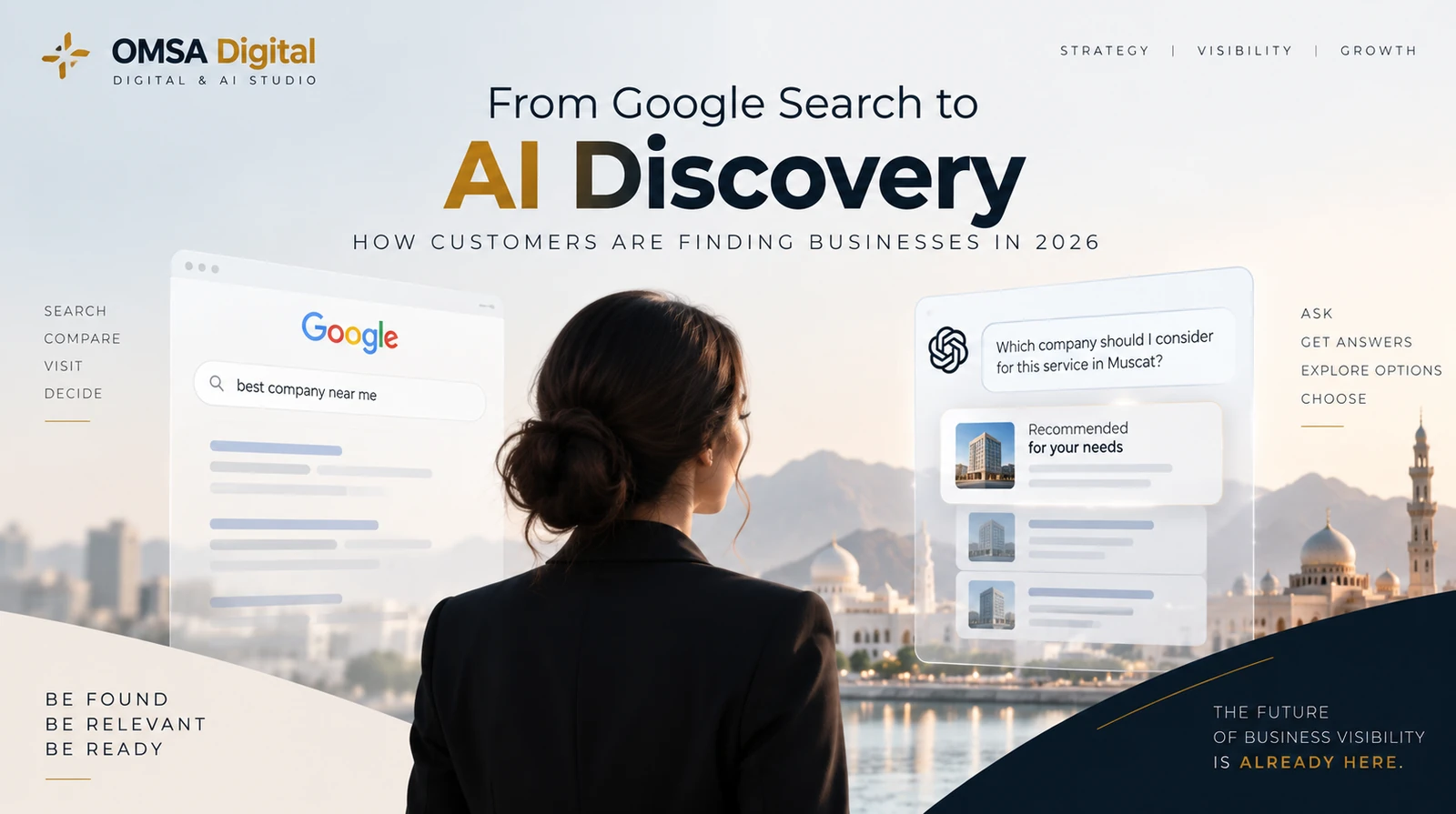
Traditional search still works the way it always has: type a query, get a page of ranked links, and do the comparing yourself. Conversational AI search compresses several of those steps into one. Instead of a list, the person gets an answer — sometimes a short list of names, sometimes a single recommendation, occasionally with reasoning attached.
The business consequence isn't dramatic on its own, but it's worth sitting with. If a prospective customer's first real exposure to a category is a synthesized AI answer rather than a page of search results, the businesses that answer names are the ones actually being considered — and the ones it doesn't name may never enter the shortlist at all, regardless of how well they'd have ranked in a traditional search.
Google ranking vs AI visibility: what is actually different?
It helps to separate the two environments across a few practical dimensions, without oversimplifying either one — Google Search itself increasingly blends ranked results with AI-generated overviews, and different AI assistants work in genuinely different ways.
- User intent: a Google search is often exploratory; a conversational AI query frequently already contains context — budget, location, use case — that shapes the answer.
- Output format: ranked links to evaluate yourself, versus a synthesized answer that has already done some of that evaluation.
- Discovery mechanism: Google's ranking is built primarily around crawling and indexing web pages; AI assistants draw on a mix of training data, live retrieval and, depending on the system, real-time web search.
- Source diversity: a business's own website is one input among many an AI system may draw on, alongside reviews, directories, news coverage and other third-party mentions.
- Citations: some AI systems show sources for an answer, others don't, and the presence of a citation doesn't necessarily mean a recommendation.
- Measurement: Google Search Console gives a business direct visibility into its own ranking data. No AI assistant currently offers an equivalent, business-owned dashboard of how often it's recommended.
Why this became a serious marketing category in 2026
This distinction has moved from a talking point to a funded category. On September 15, 2026, Profound — a company building measurement and management tools for how brands appear in AI-generated answers — announced a $180 million Series D at a $1.8 billion valuation, co-led by Sequoia Capital and Kleiner Perkins.
Profound says it now works with more than 1,000 enterprise brands, and names customers including Comcast, Walmart, Royal Bank of Canada and The Estée Lauder Companies. That last name is worth pausing on: a company like Estée Lauder investing in tools that measure how AI systems describe and recommend its brands is a signal that AI discovery is being treated as a real, budgeted marketing category by organizations with far more resources than most GCC SMEs — not a niche experiment.
None of this proves that traditional SEO is losing relevance, and it isn't evidence that any specific technique guarantees an AI recommendation. What it does show is that measuring and managing AI discovery has become commercially serious enough to attract significant investment — a reasonable signal for any business deciding whether the topic deserves attention now or later.
What feeds an AI system's understanding of your business?
AI systems don't have one single, published method for forming an understanding of a business, and different systems — ChatGPT, Gemini, Perplexity and others — combine training data, retrieval and live web search differently. In broad terms, though, it's a handful of overlapping categories: clearly written website content, structured data, consistent entity information across the web, third-party mentions, reviews, and local or business-profile details.
We've covered that picture in more depth in our look at how AI is changing business discovery. What matters for this article is narrower: those same categories are exactly what an AI Visibility Audit sets out to check, one by one, for a specific business.
None of this amounts to a deterministic ranking formula, and no reputable source claims otherwise for ChatGPT, Gemini or Perplexity specifically. Structured data, for example, makes information machine-readable rather than left for a system to infer — it hasn't been confirmed by any of these providers as a direct recommendation factor.
Why being #1 on Google does not automatically mean being recommended by AI
SEO remains genuinely important — nothing here suggests otherwise. But a page that ranks first for a specific keyword has usually been optimized for that keyword, on that page, for that search engine. An AI system forming a broader understanding of "the best real estate company in Dubai" may be drawing on a wider information environment than that one page represents, including how the business is discussed elsewhere, whether its service area and specialisms are stated consistently, and whether independent sources corroborate what it says about itself.
In practice, this means the businesses most likely to show up well in both environments tend to combine strong search visibility, AI-readable entity clarity, and a reasonably consistent, credible presence across the wider web — not just one of the three.
The AI Visibility Audit
A practical way to approach this is what we'll call an AI Visibility Audit — a diagnostic process, not a guaranteed outcome. The term isn't a standardized industry metric; it's a useful label for a structured review across a defined set of realistic customer prompts, a defined set of AI platforms, and repeated over time — not a single question typed into a single assistant once. A useful audit looks at questions such as:
One absent result on one prompt, on one platform, on one day isn't evidence that a business is universally invisible to AI — models change, answers vary, and a single test only shows a single moment. That's exactly why the audit is structured, repeatable and measured over time rather than treated as a pass/fail check. And it remains measurement and diagnosis, not control: no legitimate process can guarantee that an AI system will recommend a specific business. The goal is to understand the gap clearly enough to prioritise what's actually worth fixing.
- Does major AI/search technology appear to recognise the business as a distinct entity?
- For which realistic customer prompts does the business get mentioned — and for which relevant ones does it not?
- Which competitors show up in places the business doesn't?
- What sources do AI answers appear to be drawing on when the business or its category comes up?
- Is the business's information — name, services, location, contact details — accurate and consistent everywhere it appears?
- Are the business's services and specialisms clearly and unambiguously described?
- Are location and service-area signals strong and consistent?
- Is structured data implemented correctly on the site?
- Is there enough independent, authoritative third-party evidence — reviews, coverage, citations — supporting what the business claims about itself?
- Where AI answers do mention the business, is the description actually accurate?
Example: a Dubai real estate company
Here's a hypothetical example, not a real client case. Imagine a real estate brokerage in Dubai that ranks on page one of Google for "best real estate company Dubai" and several related keywords. Its SEO is genuinely solid.
An overseas investor, instead, asks an AI assistant which real estate companies in Dubai it would recommend for someone in their position. The brokerage doesn't appear in the answer. Possible reasons — none confirmed as the actual cause in any specific case — might include thin third-party coverage of the brokerage specifically, service and specialism descriptions that are clear to a human reader but not explicitly structured, or a stronger independent information footprint held by a competitor that ranks lower on Google but is more clearly represented elsewhere.
The point isn't that the brokerage did anything wrong. It's that Google ranking and AI recommendation are measuring different things, and a business can lead on one axis while remaining unclear on the other.
Example: a Muscat professional service business
Take a second hypothetical: a professional services firm in Muscat — an accounting, legal or consulting practice — that a business owner might approach by asking an AI assistant, "Who can help my company with [a specific service] in Muscat?"
If that firm's service pages are strong but its name, address and specialisms vary slightly across its website, directory listings and social profiles, an AI system may struggle to confidently connect those signals into one clear entity — the same inconsistency that already weakens local search performance can just as easily weaken AI understanding.
This is exactly why entity consistency and local signal clarity matter for more than one discovery channel at once — the effort isn't duplicated across SEO and AI visibility, it's shared.
What businesses in Oman and the UAE should do now
None of this requires abandoning existing SEO investment; if anything, it depends on it. A site with unresolved technical SEO issues will struggle to be crawled and understood by AI systems just as it already struggles with Google.
The sequence below is the practical, audit-first version of that groundwork — the same fundamentals, applied specifically to closing the gap between how a business ranks and how it's understood.
- Establish a baseline — test a handful of real customer prompts across a couple of AI assistants and record what comes back today.
- Review entity consistency — name, description, services and contact details, checked across the website, directories and social profiles.
- Improve service and location clarity, so specialisms and coverage areas are stated explicitly rather than implied.
- Strengthen structured data so services, location and organisational details are machine-readable, not just human-readable.
- Build a more credible independent presence — reviews, relevant press mentions, directory listings that actually match reality.
- Monitor AI mentions and citations periodically, the same way search rankings already get monitored.
- Keep investing in technical SEO fundamentals — none of this reduces their importance.
- Re-test periodically rather than once, since AI systems and their underlying models keep changing.
Ranking and being recommended are not competing goals
SEO remains foundational. It answers a question that hasn't gone away: can customers find your business at all? AI visibility adds a second, related question on top of it: can AI systems understand your business well enough to surface or recommend it when a customer asks for exactly what you offer?
Neither question replaces the other. Together, they describe a broader digital marketing picture than either one alone — search visibility and AI visibility increasingly need to be planned as one connected effort rather than two competing budgets.
Final thoughts
Ranking on Google is still worth having. It just isn't the whole picture anymore. The more useful question for a business to ask today is whether AI systems can already describe what it does, where it operates, and why it's a credible option — accurately and consistently — before a customer ever asks.
Before investing further in content, advertising or a website redesign, it's worth understanding what AI systems can currently discover about your business, and where the gaps actually are. That's the kind of foundational review worth having with a team that already treats search, SEO and analytics as one connected system.