Business Growth
More Website Traffic Doesn't Always Mean More Business: The Metrics That Actually Matter
A rising traffic chart can look like a win and still leave leads, customers and revenue exactly where they started. Here's what to measure instead.
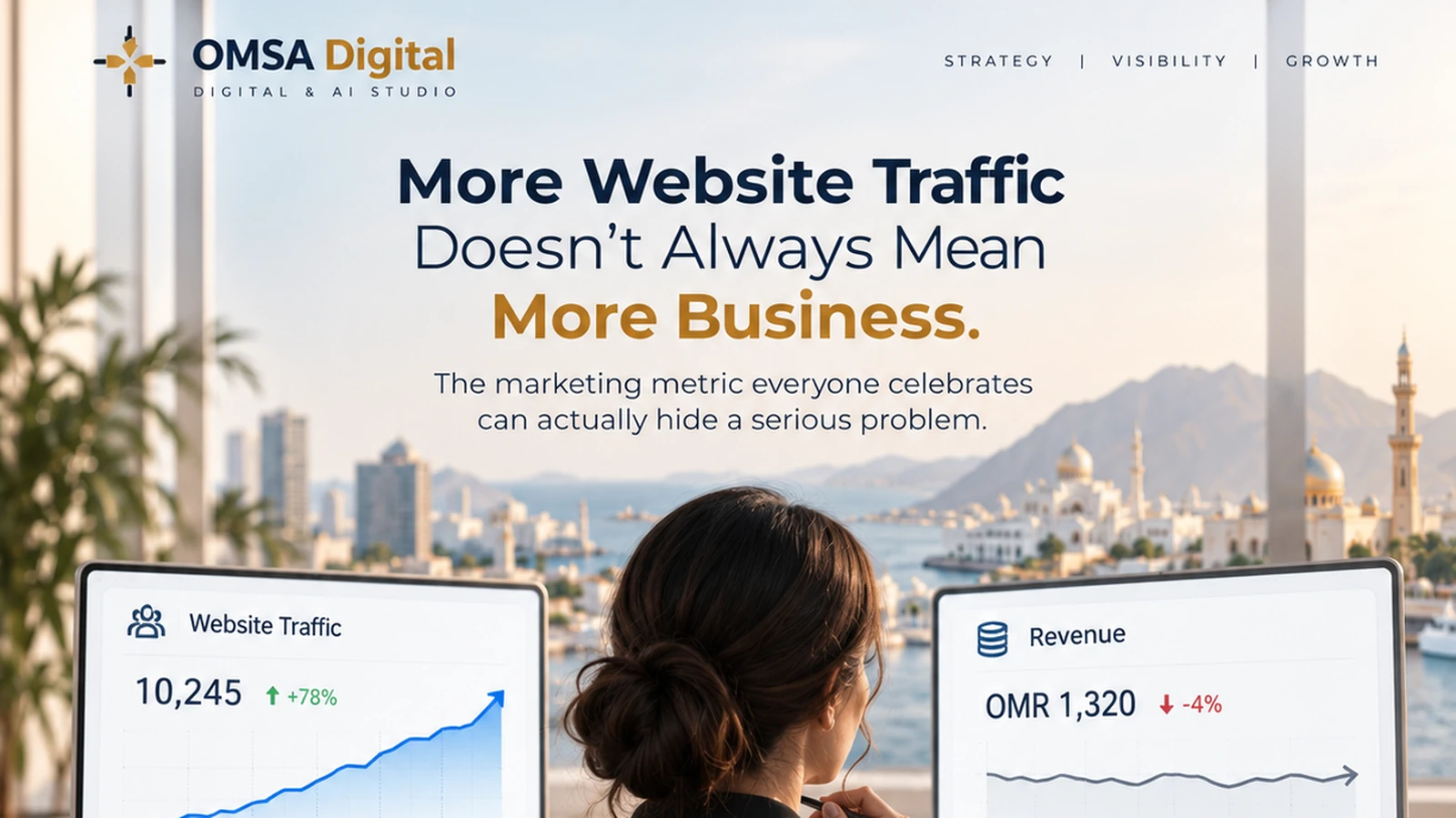
The traffic trap: when growth looks better than it really is
Your website traffic increased 80 percent this quarter. Impressions are up. Clicks are up. Sessions are up. The marketing report looks excellent. But revenue barely moved. Was the campaign successful?
This is where many businesses confuse marketing activity with business growth. Traffic is important — it's usually the first visible sign that visibility efforts are working. But traffic without context can become one of the most misleading numbers on a marketing dashboard, because a rising line doesn't say who is arriving, why, or what happens next.
Not all traffic is a vanity metric, and it would be wrong to treat it that way. The trap isn't traffic itself — it's watching a single number climb and assuming climbing is the same as winning. The better question isn't simply how much traffic a website is getting. It's what that traffic is doing for the business.
More traffic does not automatically mean more revenue
Consider a simple, illustrative scenario — not real client data, just a pattern worth recognising. In Month A, a website received 5,000 visitors, of which 150 were genuinely qualified prospects, producing 30 leads and 10 new customers.
In Month B, traffic doubled to 10,000 visitors. Qualified visitors barely moved, to 160. Leads rose marginally, to 31. Customers stayed exactly the same: 10.
Traffic doubled. Business performance barely changed. On a dashboard that only reports sessions, Month B looks like a clear win. Followed through to the end of the funnel, it produced almost nothing extra for the business.
Traffic volume vs traffic quality
Traffic quality is not a single number — it's a combination of factors that determine how likely a visitor is to become a lead or a customer: intent, relevance, geography, audience fit, source, how well the landing page matches what they were looking for, and where they sit in their own buying journey.
A visitor searching for a general definition is not the same as someone actively comparing service providers in their city. Both count identically in a traffic report. Only one of them is close to a decision.
Why website traffic can increase while sales stay flat
There isn't one universal explanation, and most businesses have one or two of these at play rather than all of them at once. Common causes include:
- The wrong audience is arriving — visible in analytics, irrelevant to the business.
- Traffic carries low commercial intent — informational visits rather than buying research.
- Landing pages don't match what actually brought the visitor there.
- The value proposition isn't clear once someone arrives.
- Friction in the conversion journey — too many steps, no obvious next action.
- A weak mobile experience, where a growing share of traffic now arrives.
- Incomplete or broken conversion tracking, hiding activity that's actually happening.
- Calls to action that are vague, buried, or missing entirely.
- Traffic arriving from markets or regions the business doesn't actually serve.
- Campaigns optimized for clicks rather than for qualified outcomes.
The metrics business owners should actually watch
No single metric is universally superior — the right KPI depends on the business model, sales cycle, and how a customer actually buys. But a handful of measures consistently say more than raw traffic ever can.
- Conversion rate — the share of visitors who take a meaningful action, not just arrive.
- Qualified leads — enquiries that genuinely match what the business sells and to whom.
- Lead-to-customer rate — how many qualified leads actually become paying customers.
- Cost per acquisition (CPA) — what it genuinely costs to win one customer, not one click.
- Customer acquisition cost (CAC) — the fully loaded cost of acquisition, where it can be measured.
- ROAS — return on ad spend, for any campaign carrying a media budget.
- Revenue or conversion value — what a conversion is actually worth, not just that it happened.
- Landing-page conversion rate — performance of the specific page traffic actually lands on.
- Source/medium performance — which channels produce outcomes, not just visits.
- Engaged sessions — useful in context, not as a substitute for a conversion metric.
- Funnel drop-off — where in the journey prospects are actually being lost.
Traffic → intent → conversion → revenue
It helps to hold the whole chain in view rather than any single link in it: traffic, relevant audience, intent, conversion, qualified opportunity, customer, revenue.
Optimization aimed at just the first link — more traffic — can leave every later link exactly where it was. A campaign that improves relevance and intent, even without moving the traffic number at all, often moves revenue further than one that doubles visits with no attention to what happens next.
Why conversion rate alone can also mislead you
Conversion rate is a real improvement over raw traffic, but it isn't immune to the same trap. A campaign can convert visitors at a high rate while producing leads that rarely close, or customers who spend very little once they arrive.
Another campaign might convert a smaller share of visitors, yet produce customers of meaningfully higher value. Conversion quantity and conversion quality are different questions, and a report that only tracks the rate answers just one of them.
Where GA4 fits into this
Google Analytics 4 is built to answer more of that question than a traffic report alone can. Used well, it can show which acquisition sources bring visitors, which events and key actions those visitors actually take, which landing pages hold attention, how users move through a journey, and how individual campaigns compare against each other.
It isn't perfect revenue attribution — cross-device behaviour, privacy settings and offline conversions all limit what any analytics platform can see with certainty. But used honestly, GA4 moves a business meaningfully closer to seeing outcomes rather than just activity.
SEO traffic: more organic visitors or more business opportunities?
SEO success shouldn't be judged only by rankings, impressions, clicks or organic sessions — each describes visibility, not outcome. A page can rank well and attract volume while contributing very little to pipeline.
A more complete view asks what search intent that traffic represents, whether commercial pages are the ones gaining visibility, and whether the resulting paths actually lead toward a conversion — questions a broader SEO strategy should be built around from the start, not added afterward.
None of that matters if the underlying pages are difficult to crawl, slow to load, or structured in a way that hides the content search engines and visitors are looking for — which is where technical foundations, not just content and keywords, start to matter.
Paid advertising: clicks are easy. Profitable growth is harder.
Paid campaigns make the trap easy to fall into, because platforms report activity in real time and clicks are the easiest thing to buy more of. Click-through rate and cost per click describe how efficiently a campaign is buying attention — they say nothing about what that attention is worth.
Those numbers only become meaningful once they're connected to what happens after the click: conversion quality, cost per acquisition, return on ad spend, and the revenue a campaign actually produces. Judged on clicks alone, paid media can look increasingly efficient while contributing less and less to a broader digital marketing strategy built around real outcomes.
AI is making traffic quality even more important
Discovery is increasingly distributed across traditional search, AI assistants, social platforms and other channels, rather than concentrated in one results page. Raw website traffic can end up representing a smaller share of the complete customer journey than it used to, even for a business whose overall visibility is growing.
That shift, covered in more depth in our look at how AI is changing business discovery, makes stronger measurement more important, not less — when part of the journey happens before a visit ever occurs, the traffic a business can measure directly tells an even smaller part of the story.
A simple marketing measurement framework for businesses
One useful way to organise all of this is as five layers, each one step closer to actual business value than the one before it.
The further down this list a metric sits, the closer it gets to real business value. But the layers above it still matter — they explain how those customers arrived in the first place, and where to look when a lower layer underperforms.
- Layer 1 — Visibility: impressions, rankings, reach.
- Layer 2 — Acquisition: sessions, clicks, traffic sources.
- Layer 3 — Engagement & intent: key page visits, relevant actions, high-intent behaviour.
- Layer 4 — Conversion: leads, bookings, purchases, qualified enquiries.
- Layer 5 — Business outcome: customers, revenue, CAC/CPA, ROAS, lifetime value where measurable.
How to know whether your marketing is actually working
Instead of asking how many visitors a website received, a more useful audit asks a different set of questions:
- Where did visitors actually come from?
- Why did they arrive — what were they looking for?
- Which pages did they visit once they landed?
- What did they do next?
- Which sources produced genuinely qualified leads?
- Which of those leads became paying customers?
- What did acquiring them actually cost?
- What revenue or value resulted?
- Where in the journey are prospects dropping out?
The real goal: better traffic, not just more traffic
A hundred relevant visitors can sometimes be worth more than ten thousand irrelevant ones — though that isn't a universal formula, and the right balance depends entirely on the business, its margins and its sales process. The point isn't a specific ratio. It's that quality and commercial relevance decide what traffic is actually worth, not the size of the number alone.
Better traffic beats more traffic almost every time it's genuinely available. The harder, more useful work is building the visibility, positioning and journey that earns it.
Final thoughts
More traffic can look impressive on a dashboard. But businesses don't grow because a chart moved upward. They grow when the right people discover them, understand what they offer, take meaningful action, and become customers.
So the next time a report says traffic increased, it's worth asking one more question: what did that increase actually do for the business?
If your own reports show more traffic without a clear line to leads, customers or revenue, the problem may not be traffic — it may be measurement. Connecting SEO, analytics and digital strategy to real business outcomes is exactly the kind of review worth having before increasing spend on any single channel.