Digital Marketing
The Next Ad Might Be a Conversation: How Sponsored AI Agents Could Change Digital Advertising
OpenAI is testing Sponsored Agents inside ChatGPT Ads — a business-sponsored conversation you can open from an ad. Here's what's actually confirmed, and what it could mean for advertising.
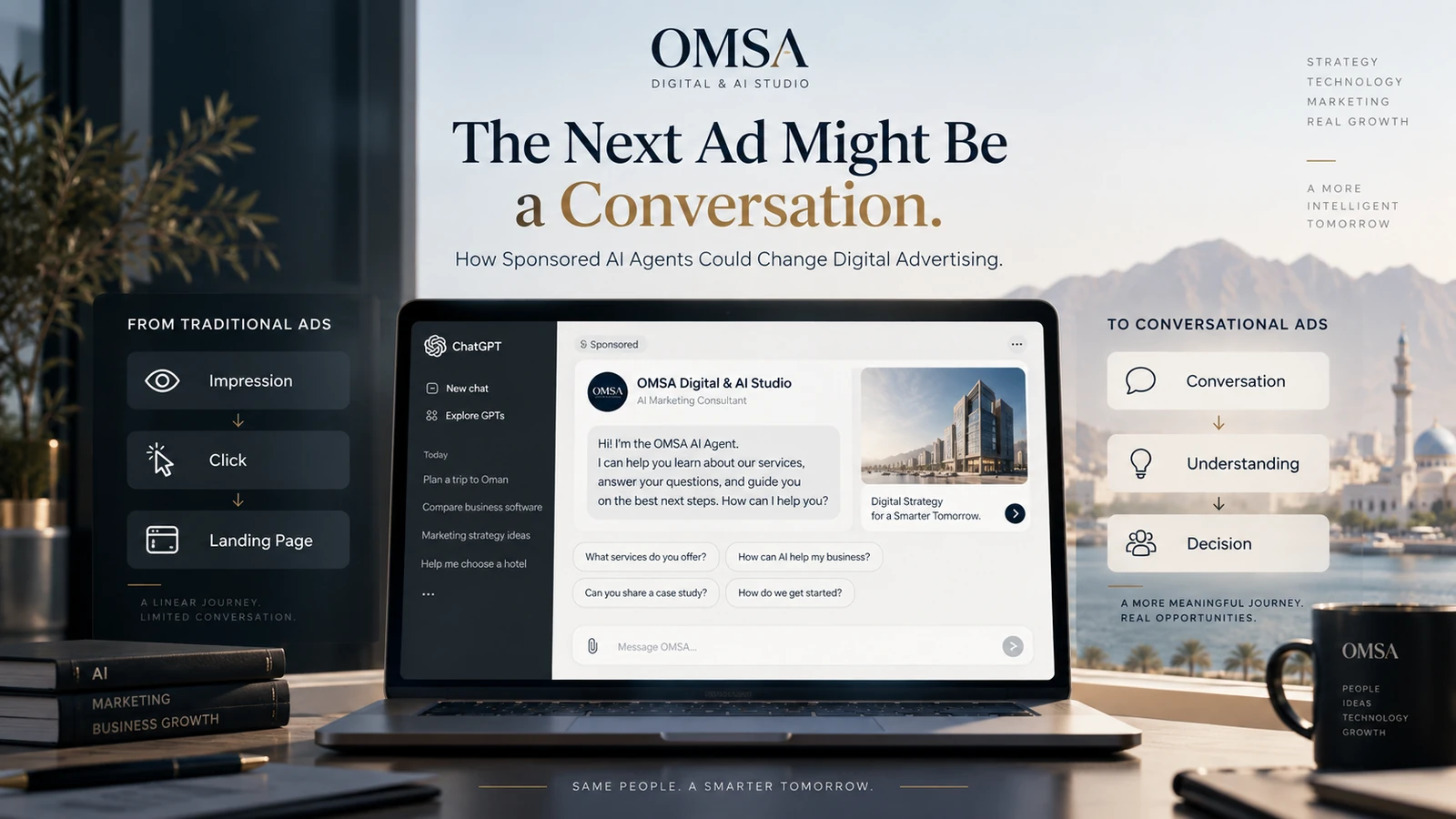
The next ad might not just be an ad
For years, digital advertising has followed a familiar path: an impression leads to a click, a click leads to a landing page, and the landing page is where the real work of informing and converting a customer happens. The ad's job was simple — get attention, then send people somewhere else.
OpenAI's latest advertising experiment points toward a different question: what happens when the advertisement itself can hold a conversation? On September 16, 2026, OpenAI began testing "Sponsored Agents" inside ChatGPT Ads — business-sponsored AI conversations that a person can enter directly from an ad.
This doesn't mean landing pages or traditional advertising are disappearing. But it may signal a real shift in what happens between discovery and decision — worth understanding whether or not your business ever runs a Sponsored Agent campaign.
What are Sponsored Agents in ChatGPT?
A Sponsored Agent is a business-sponsored AI conversation that a ChatGPT user can choose to open from a clearly labeled ad. Instead of only clicking through to a website, the person can ask the agent questions, describe what they need, and decide whether to visit the business's site once they have an answer.
This is currently a test, not a general product. In its September 16, 2026 announcement, OpenAI said it was limiting Sponsored Agents to a select group of advertisers in the United States — it is not available to every advertiser, and no timeline for wider access has been confirmed.
OpenAI has also been explicit that a Sponsored Agent conversation stays separate from a user's own ChatGPT conversation and from ChatGPT's independent answers — sponsorship does not extend into the assistant's organic responses.
How could a Sponsored Agent experience work?
It helps to compare the two journeys conceptually, since this is still an early test and OpenAI hasn't published one fixed, guaranteed flow. Traditional: an ad appears, someone clicks, they land on a page, they search that page for the specific information they need, they compare it against alternatives, and — sometimes — they convert.
Conversational, as OpenAI describes it: a relevant ad appears, the person opens a conversation instead of just clicking, they ask the specific question they actually have, the agent responds directly, and they decide whether to continue on to the business's website.
That's a conceptual customer journey, not a guaranteed outcome. It describes what the format makes possible, not what every interaction will produce.
Traditional advertising vs conversational advertising
Comparing the two formats side by side is useful for seeing what actually changes.
Neither format is universally better — they simply create different opportunities depending on what a customer needs in that moment.
- Traditional: the message is largely predefined, and every visitor sees the same core creative.
- Conversational: the interaction can respond to the specific question a person actually asks.
- Traditional: a click sends the user elsewhere, and the landing page has to anticipate their questions in advance.
- Conversational: the person can reveal their own intent through dialogue rather than being guessed at.
- Traditional: the path from ad to decision is relatively linear.
- Conversational: decision support can happen inside the conversation itself, and the journey may be less linear.
Why this matters for digital marketing
If conversational formats grow, advertising may increasingly compete on usefulness, context, relevance and the quality of the answers it can give — not only on headline, image, call-to-action and click-through rate.
That's an analysis of where the format could push the industry, not a claim that OpenAI has published usefulness as a ranking factor. But it's a reasonable strategic assumption: an ad that can actually answer a question carries a different kind of value than one built only to capture attention.
From click optimization to conversation quality
The traditional campaign question has always been: how do we get the click? A conversational format adds a second question worth asking: how useful is the interaction once attention is captured?
That shifts what a business needs to prepare — not just a compelling headline, but real answers to the questions a prospect is likely to ask: what does this cost, does it fit my situation, how is it different from the alternative, what happens after I say yes. A conversation that handles those well takes on some of the qualification and decision support a landing page currently has to do alone.
Does this mean landing pages are becoming obsolete?
No. Websites and landing pages remain essential for what a chat window inside an ad isn't built to replace: proof, detailed specifications, transactions, legal and compliance information, brand ownership, analytics, and being found through search and AI discovery in the first place.
What may change is their role earlier in the journey. If a conversation can already answer someone's basic questions, a landing page's job shifts further toward confirming the decision and completing it — not making the very first case.
ChatGPT Ads are bigger than Sponsored Agents
Sponsored Agents are one experiment inside a larger, faster-moving advertising platform. Over 2026, OpenAI introduced a self-serve Ads Manager with cost-per-click bidding and conversion measurement tools, added AI-assisted tools for building campaigns and creative, and — alongside the Sponsored Agents test — announced integrations that let businesses manage ChatGPT ad campaigns from HubSpot (its first CRM partner) and, for US-based merchants, directly from the Shopify App Store, its first ecommerce partner, with an international rollout to markets where ChatGPT Ads are available beginning September 23.
By the end of August 2026, OpenAI reported ChatGPT Ads had reached roughly $1 billion in annualized revenue run rate across tens of thousands of advertisers — a sign the underlying platform is scaling well beyond any single feature test.
AI is changing the advertising funnel
Traditional funnel: impression, click, landing page, conversion. What Sponsored Agents point toward is a longer, more conversational version: visibility, relevance, conversation, understanding, decision, conversion.
Both are conceptual frameworks, not formulas — no platform publishes a guaranteed sequence, and most real customer journeys are messier than either diagram suggests. What's useful is the direction: more of the work of a sale may start happening inside the discovery moment itself, rather than only after someone leaves it.
What could this mean for SEO and AI search?
It's worth being precise about a distinction that's easy to blur: being shown as an advertisement and being organically understood, retrieved or recommended by an AI system are different things. Sponsored Agents are paid placements — OpenAI has said these conversations remain separate from ChatGPT's own independent answers, and there's no indication that advertising spend influences what ChatGPT says organically.
That separation matters, because it means paid AI-native advertising and organic AI visibility — the subject of our look at how AI is changing business discovery — are two different investments, not one. A business could run Sponsored Agent campaigns and still be poorly understood by AI systems answering unpaid questions about its category, or vice versa.
Over time, businesses may need both: a genuinely strong organic AI and search presence, and a deliberate approach to paid placements as AI-native ad formats mature — which is exactly why a technically sound SEO foundation doesn't become less important as advertising gets more conversational. It becomes part of a wider visibility picture.
What could this mean for marketing analytics?
This connects directly to a broader measurement problem: more activity doesn't automatically mean more business. If conversational ad formats become common, the metrics worth watching may expand — not replacing clicks and conversions, but sitting alongside them: conversation starts, the depth of a meaningful interaction, qualified engagement, and what happens downstream once someone leaves the conversation for a website.
None of those conversational metrics are exposed by OpenAI's current advertiser tools as of this writing — this is a direction marketers may need to prepare measurement for, not a dashboard that exists today. It's the same principle behind why more website traffic doesn't always mean more business: activity and outcome are not the same thing, whatever the channel.
Getting the fundamentals right now — clean conversion tracking, a clear definition of a qualified lead, and a reliable Google Analytics 4 setup — is what will let a business actually measure any new format well once it's available, rather than guessing at its impact after the fact.
What Sponsored Agents could mean for ecommerce
OpenAI's own example is a shopper looking at a dining table ad who wants to know whether it fits their space, how many people it seats, or how to care for its finish — questions a static ad creative can't answer but a conversation can.
For ecommerce businesses more broadly, the same logic applies to product comparisons, specifications, sizing and suitability — the kind of pre-purchase questions that today get answered by a product page, a support chat, or not at all before someone abandons the ad. The Shopify integration announced alongside Sponsored Agents gives some US-based merchants a path to manage ChatGPT ad campaigns directly, though it doesn't mean every Shopify store gains a Sponsored Agent automatically — the conversational agent format itself remains part of the limited test.
What this could mean for service businesses
The same idea applies well beyond ecommerce. A law firm, a consultant, a real estate company, a hospitality brand or a healthcare provider often loses prospective clients not because the service is wrong for them, but because they couldn't get a specific question answered before deciding whether to make contact at all.
Conversational advertising, if it matures beyond its current test, could reduce some of that information friction — letting a prospective client ask about pricing structure, availability or fit before ever picking up the phone. It's the same underlying idea behind a well-built AI chatbot on a business's own website: answering real questions at the moment someone is actually asking them, rather than after a delay.
What this means for businesses in Oman, UAE and the GCC
On August 31, 2026, OpenAI announced that advertisers could begin purchasing ChatGPT Ads directly through Ads Manager across India, Europe, and the Middle East and North Africa. That's a meaningful signal for advertisers in the region — but it's a statement about the broader advertising platform's purchasing access, not confirmation that Sponsored Agents specifically are available to businesses in Oman, the UAE or elsewhere in the GCC. As of this writing, that test remains limited to select advertisers in the United States.
The strategic opportunity for Muscat, Dubai and wider GCC businesses isn't to chase a format that isn't available to them yet. It's to start building the digital foundations — clear service information, consistent entity signals, dependable analytics — that will matter regardless of which AI-native ad formats eventually reach the region, and that already matter for how AI systems understand a business today.
How businesses can prepare for conversational advertising
None of this requires waiting for general availability. The groundwork is largely the same work that improves a business's marketing today.
Several of the items below are exactly the kind of operational groundwork that a broader business automation effort already tends to clean up — consistent data, reliable tracking, and information that's actually structured rather than scattered across a website.
- Make product and service information explicit rather than implied by design alone.
- Improve entity clarity — a consistent name, description and service list wherever the business appears.
- Document the questions customers actually ask before buying, not just the ones marketing assumes they ask.
- Strengthen FAQ content with real, specific answers.
- Fix conversion tracking so the business can tell what's actually working.
- Make sure landing pages answer real objections, not just repeat the ad's headline.
- Structure product and service data clearly, including where structured data genuinely helps.
- Build analytics that connect activity to outcomes, not just to traffic.
- Invest in organic AI and search visibility alongside any paid experimentation.
- Define what a qualified lead actually means for the business, in writing.
The bigger shift: advertising is becoming interactive
Zoom out, and this fits a longer pattern: advertising has moved from static banners, to search ads matched to a typed query, to social feeds tuned to behaviour, to increasingly personalized creative — and now to formats experimenting with actual back-and-forth conversation.
That evolution isn't complete, and it isn't guaranteed to follow a straight line — Sponsored Agents are a test, not a finished product, and plenty of conversational-advertising experiments across the industry have stalled before reaching scale. But it is evidence that conversational advertising has moved from a hypothetical to something a major platform is actively building and measuring.
Final thought
For years, marketers optimized the path from impression to click. The next phase may require optimizing what happens after attention is captured — when a customer can ask questions, challenge an offer, compare options, and decide what to do next without immediately leaving the conversation.
The question may no longer be only whether they clicked the ad. It may increasingly become whether the conversation was useful enough to move them forward.
AI is changing not only how businesses are discovered, but how customers may interact with them before making a decision. If your business is preparing for AI-powered search, conversational experiences, automation and better marketing measurement, OMSA Digital & AI Studio can help build the digital foundation behind that transition — from technical fundamentals to a broader digital marketing strategy built around real outcomes.